Midwater trawls
Midwater pair trawl
( wheel )
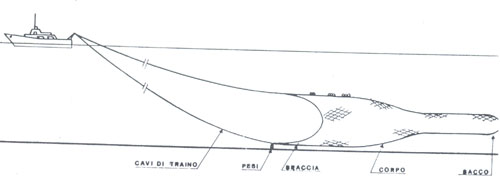
This kind of gear is mainly used to catch pelagic fishes: anchovies, sardines, mackerels, and grey mullets. Unlike bottom trawl nets these nets don’t have to be necessarily placed on the bottom of the sea but can be dragged in any sea layer, from surface to the bottom itself. The length of the warps determines the layer where the net is dragged. This fishing is done by day, usually in close proximity of the bottom. These nets can have a high vertical spread and can work like french bottom trawls, if longer warps are used and with some devices to avoid breaking them.
Midwater pair trawls are
made of four panels that are equal two by two in the number and meshes
dimensions and in the netting yarns used (the upper panel is equal to the lower,
side panels are equal to one another). These nets have four wings in the front
part. There are leads on the footrope and two big weights are set at the end of
lower wings in order to have high vertical spreads. Meshes in the front part of
the net are very wide (they go from side of100 mm minimum up to 1 metre in
certain cases) because the main task of the front part of the net is to gather
fishes in the centre as the net is dragged. These nets can have very wide
spreads.
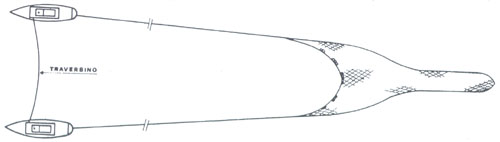
In Italy a pair of boats
usually does this fishing, both very powerful. These boats move holding the same
course at the same speed. Each of them drags two warps linked to the side wings
of the net. Upper and lower panel have wider meshes than the side panels, so the
whole gear is wider than higher. This because shoals too, in the sea zones where
this fishing is done, are wider than higher; and because it’s easy to obtain a
good horizontal spread with two boats, as it depends from the distance between
the boats, much easier that it would be using doors. While fishing at depths
below 30-40 metres, a rope, called selvage-rope, links the two boats to help
keeping the distance between them and the horizontal spread stable.
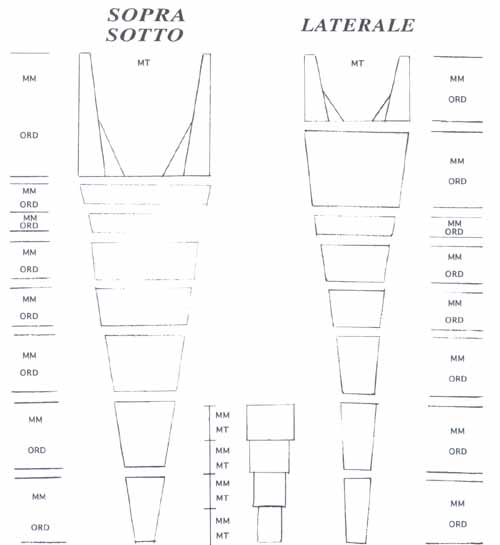
 knotted