Beam trawl
Rake trawl
To increase the catch of soles and similar species that normally live on the bottom of the sea, cutters were added to the beam gear used for this fishing, in order to force them to rise. The gear that derived from it was called harpoon. This gear gave several problems and was soon replaced by another, called rake trawl, that is a further evolution.
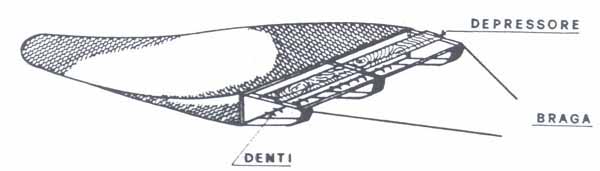
The cutters are not perpendicular, as they were in the harpoon, but are bent and inclined forward. They are set on a slide that allows them to penetrate into the ground just for few centimetres. This penetration must be kept as stable as possible in order to be always effective and because an increasing friction would impair them too fast. Gradually these cutters wear out and the fishermen hammer them to change their inclination, until when they are completely worn out and are replaced.
A board called depressor, inclined forward, is set on the upper part of the frame, and while fishing, owing to hydrodynamic thrust, it pushes down the rake trawl and the cutters in particular, allowing a good penetration at all speeds. Indeed, if speed increases the thrust downward increases too, so that it’s possible to use the rake trawl even at high speed. The net, which is directly linked to the frame, is made of a yarn whose diameter is big enough to resist the friction with the bottom of the sea, and in the lower part of the net there is usually a strengthening bag and a rubber chafer. The frame is not wider than 4 metres for handiness reasons.

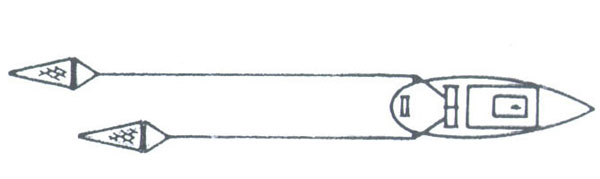
A fishing boat can trawl from 2 to 5 of them, it depends on its power. Each rake trawl is linked to a warp through a backstrop. The rake trawl is generally used by night as an alternative to trawl nets: often these two gears are taken aboard together. The casts are short because cutters have to be frequently cleaned to keep their effectiveness.
construction scheme
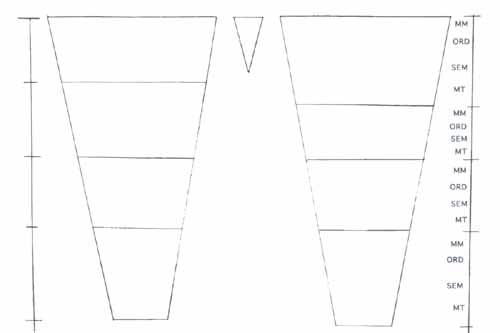
made of polyamide
net  knotless 13/16