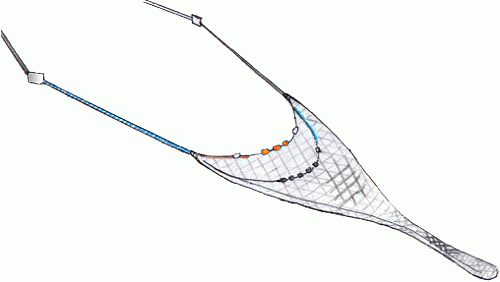
Trawl gears

Tartan (Italian bottom trawl)

Warp Door Combined rope Rigging Headline Depth floats Footrope Leads Polyamide cabled netting twine Polyamide net

Before the coming of engines, when sailing boats were used, it wasn’t possible to have constant trawling as it mostly depended on weather conditions. For this reason two boats were used for bottom trawl so that the net could have a horizontal spread as stable as possible. With the coming of engines only one boat is used and the horizontal spread is given by a pair of  “doors”, only very few boats go on doing bottom trawl in two.

Let’s see now the single parts of this trawl gear, starting from the two warps. These warps are generally made of zinc plated steel, but many fishermen are starting to use stainless steel warps because they are more resistant to time wear, even though more expensive. The length of these warps is determined by the depth of the sea in which it’s meant to work and by the trawling resistance of the gear used. Anyway the ratio depth/length of these warps is not linear as, once in the water, the warp doesn’t place itself in straight line but takes a shape similar to a catenary. Net winches, which generally work with oil pumps, are used to cast and haul in these warps. The warps end to doors that are dragged inclined compared to the direction of advancement. The hydrodynamic pressure that water exerts on the door surface generates a thrust that is perpendicular to the surface itself. As the door is inclined, part of this thrust is mere resistance to motion, while the other part is a thrust that tends to spread the door to a point of balance with the resistance of the rest of the gear. The distance between doors determines the horizontal spread of the net, so the dimensions of door are strictly connected with those of the net used. An arc is used to connect the door and the warp; the arc is fastened on the inner and front part of the door. The angulation of this arc, which is set changing the length of two chains that are fastened in the rear part, determines the inclination that the door has on the water. The door is linked to the sweep through the backstrop. The backstrop is made of two pieces of rope whose length contributes to the vertical inclination of the door. The door is generally kept with its point upwards in order to avoid the risks of sanding up and easily overcome any obstacle. The sweep is usually made of polyamide-steel (or polyethylene-steel, coco-steel) combined rope. The ending part is called mudrope, and it has a bigger diameter than the previous one. The mudrope is linked, directly or through a piece of chain with very big links, to the big points of the wings of the net, that are the riggings.
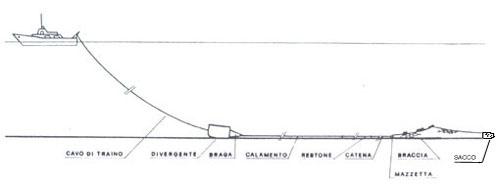
Both the ending meshes of the wings of the net and the headline and footrope are linked to the riggings. Depth floats, whose function is to give the vertical spread, are set on the headline. Leads or chains are set on the footrope so to ensure the contact with the bottom of the sea. Both the floats and the leads are not placed uniformly on headline and footrope, but are accumulated in the middle. The body of the net follows the wings. The body is made of two asymmetric panels: the upper panel is larger and shorter, the lower one narrower and longer. The upper panel, the bating, also acts as side panel, is generally made of polyamide (nylon) or of polyethylene (plastic). It is made of a series of nettings whose meshes dimensions decrease more and more. The lower panel, the belly, is much longer than the bating, about 35% longer. In fact it is given a certain slack to ensure it a good contact with the bottom of the sea. For this reason the belly is made of a material that must resist to abrasion rather than to traction: usually it’s made of polyamide with a bigger diameter than the one used for the bating, or of polyester. In the middle of both panels are set two nettings that have the shape of a triangle, often these are hand made, and their function is to make the rigging (the link) of the net with the mid part of the headline and footrope easier. The central parts of the net are called upper bosom and lower bosom. At the end of the two panels is the codena. Often the final parts of the belly and the lower part of the codena are further protected against abrasion adding pieces of net or rubber chafers. The whole gear dimensions (warps diameter and sweeps diameter, door surface, number and dimensions of the net meshes, number of depth floats and leads, ...) depend on the fishing vessel power.

Construction scheme
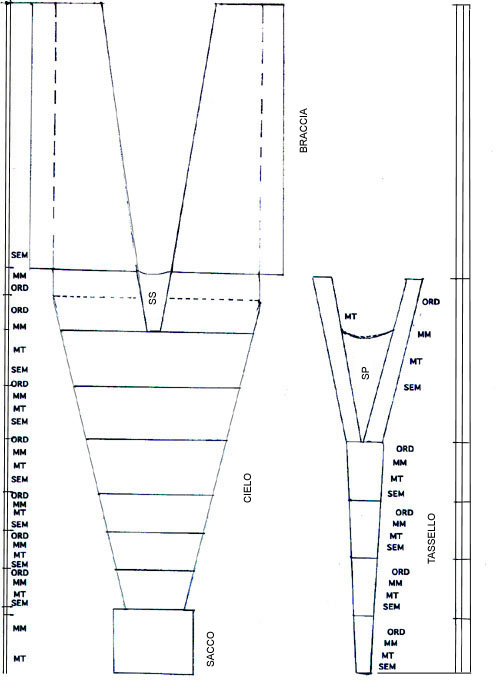
made of polyamide net  knotless